

On the occasion of the Mahalaya Shraddha, let us bow to all the Vedic scholars and learn about Pitrupaksha. The scholars define Shraddha as that which is performed with shraddha (Faith).
In today’s scientific age, the mention of Shraddha often creates a false image in the minds of the younger generation – of it being an unscientific and meaningless ritual. One of the fundamental principles of God-realisation as mentioned by Hindu Dharma, is repaying the four debts – Devarin (Debt unto Deities), Rushirin (Debt unto Sages), Pitrurin (Debt unto ancestors), and Samajrin (Debt unto society). Of these, Shraddha is essential for repaying the Pitrurin.
The mantras chanted during Shraddha contain subtle energy to help the ancestors progress to the next plane. Offering the havirbhag (Portion of the oblation) to them during Shraddha satisfies them. This frees the ancestors from the distress they are facing, thus making our own lives more bearable. Despite the great importance of Shraddha, due to lack of education on Dharma among Hindus today, their distrust in Spirituality and their blind imitation of Western culture, Shraddha is being neglected or dismissed as an unnecessary ritual. Therefore, it is necessary to explain why Shraddha is as important as any other Vedic ritual.
Some feel that worship, Shraddhapaksha, etc., are unnecessary and that social service has utmost importance. ‘Instead of performing the Shraddha ritual, we will donate food to the poor or give aid to a school’, they say. However, this is like saying, instead of operating on a patient, we will feed the poor or help a school. The aim of this article is to remove the ignorance and blind faith, and help society develop a positive and spiritual scientific outlook towards Shraddha, a sacred ritual of Hindu Dharma.
Purpose of performing Shraddha
Not all the lingadehas (Subtle bodies) of the individuals perform spiritual practice; so they must be propelled forward with the help of external energy through rituals such as Shraddha. Hence, Shraddha becomes important. Its main purpose is to reduce the vasanamayakosh (Sheath of desire) around the lingadeha, lighten it, and help it progress by the energy generated through mantras.
- To assist ancestors who have reached Pitrulok (Region of the departed ancestors) to progress to higher planes through the Shraddha ritual.
- Some deceased family members do not attain sadgati (a good afterlife) due to unfulfilled desires, and remain in the lower planes. Their desires are fulfilled through the Shraddha ritual, thus, helping them progress.
- Due to their evil deeds when alive, some ancestors enter the bhootyoni (A ghostly existence). They can be liberated through the shraddha ritual.
Pitrupaksha (Mahalayapaksha)
The dark fortnight of lunar month of Bhadrapad is called Pitrupaksha. This period is dear to the ancestors since performing Mahalaya Shraddha during this fortnight satisfies them for a year.
सूर्ये कन्यागते श्राद्धं यो न कुर्याद् गृहाश्रमी ।
धनं पुत्राः कुतस्तस्य पितृनिःश्वासपीडया
– Gargya (Shraddhakalpalata, Page 97)
Meaning : A householder who does not perform Shraddha when the Sun is in Virgo (during Pitru-paksha) is afflicted by the distressing sighs of the ancestors. How will he get wealth or progeny ?
When Pitrulok is empty during this period, it means that the ancestors come to their descendants to bless them, and if Shraddha is not performed, they curse them before departing. Therefore, it is important to perform Shraddha during this time.
If the father or any other relative has passed away on the Purnima (Full Moon) tithi, then during this fortnight, Shraddha should be performed on the day of Bharani Nakshatra, Ashtami, Dwadashi or Amavasya.
(Ref.: Sanatan’s Text – ‘Spiritual science underlying various actions in Shraddha’)
Importance of Sarvapitri Amavasya
The Amavasya of Bhadrapad in Pitrupaksha is called Sarvapitri Amavasya, when Shraddha is performed for all ancestors. Even if one has not been able to perform Shraddha during the rest of the year or on other tithis of Pitrupaksha, it is very important to perform it on this day, since it is the last tithi of Pitrupaksha. Scriptures say that while Amavasya is generally the most appropriate tithi for Shraddha, Amavasya of Pitrupaksha is the most appropriate of all.
On this day, at least one Brahman is invited for a meal. In communities such as Koli, Thakur, Katkari, Kunbi, etc., on this day, rice or flour balls (known as pinda) are offered to the ancestors, and people from their own caste are invited for meals. Among them, there is also a custom of giving provisions to Brahmans on this day.
The necessity of Shraddha
By performing the Shraddha ritual, the ancestors are satisfied, and attain further momentum : Nowadays, since most people do not perform Shraddha, almost everyone suffers from the effects of dissatisfied ancestors lingadehas. Only spiritually advanced individuals (meaning Saints) can say if our ancestors are troubling us or if there is a possibility of trouble in the future. The following kinds of problems may be assumed to be caused by ancestors – constant quarrels at home, disharmony among family members, inability to get a job or save money, serious illness, inability to get married despite favourable conditions, discord between spouses, inability to conceive, miscarriages, children born mentally challenged or disabled, some family member developing addictions.
When Shraddha rituals are performed, the ancestors become content and bless the descendents. As the ancestors trapped in Martyalok (Region of the dead) attain momentum, the troubles caused by them are resolved.
The lingadeha (Subtle body) attains sadgati through action-oriented Yama waves after performing Shraddha
Performing Shraddha means invoking the energy predominant Yama waves in the Universe to impart momentum to the lingadehas of the departed ancestors. This invocation in the form of a prayer activates ichha (Will) waves related to the Deity Datta Principle in the Universe, and with the power of attraction, they draw Yama waves associated with the ancestor’s lingadeha into the Earth’s orbit. Many lingadehas are trapped in the Martyalok. To impart momentum to them, action-oriented Yama waves are required. When these active Yama waves are invoked in the Shraddha-karma (Rites of Shraddha), the environment around lingadehas of the departed ancestors gets activated, and the subtle body attains momentum in the journey towards God. – A Scholar (Shrichitshakti [Mrs] Anjali Gadgil writes under this pseudonym; 1.3.2005)
Why perform Shraddha according to the Tithi (Lunar date)
When this happens through Divine planning, meaning, the confluence of Pravrutti (Inclination towards participation in worldly affairs) and Prakruti (Primeval Nature), it manifests in a sagun (Materialised) form at the three levels of will, action, and knowledge, with the help of the corresponding Shakti (Divine Energy). The tithi is the original form of energy, essential for and strengthening Prakruti, while the karma performed in the name of a particular individual on that tithi supports the Pravrutti arising from it, meaning, it assists in the attainment of the result. It is important to perform every activity on the specific tithi and at the specific muhurt (Auspicious time); because on this day, the vibrations emerging from the time-cycle of the corresponding incidental karmas, the actual chronology of events and the result obtained are all similar, that is, complementary to each other. The tithi activates the waves necessary to bring that sequence of events to completion. – A Scholar (Shrichitshakti [Mrs] Anjali Gadgil writes under this pseudonym; Sanatan Ashram, Ramnathi, Goa, India, 12.8.2005, 6.02 p.m.) |
 Generally, Amavasya (New Moon day), the twelve Sankrantis (Sun’s transit) in a Year, solar and lunar eclipses, Yugadi and Manvadi tithis, Ardhodaya days, date of death (as per tithi), and occasions of arrival of a Shrotriya Brahman are auspicious for performing Shraddha. Every activity takes place due to some cause-and-effect. Its success depends on the doer, the correct timing, and the place of performance. When all these are complementary to each other, the fruitfulness of the activity, that is, fulfillment takes place.
| Due to lack of education on Dharma among Hindus today, Shraddha is being neglected or dismissed as an unnecessary ritual ! |
 SPECIAL EDITORIAL : The Constructive Spirit of American Youth!
 Committees to be constituted in Maharashtra to decide cases of passive euthanasia
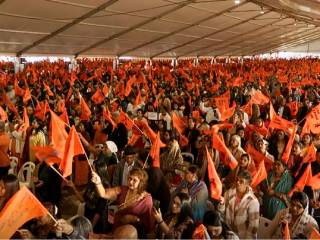 17,000 Hindus in South Africa gather to recite the Hanuman Chalisa !
 Actor Aamir Khan receives death threat from Lawrence Bishnoi gang over ‘Love Jihad’
 We pay our obeisance a million times on the Birthdays (as per Tithi) of
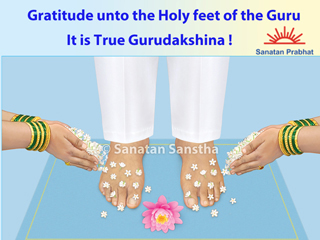 Offering gratitude unto the Holy feet of the Guru is true Gurudakshina !